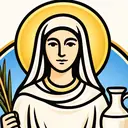
 St. Verena's
The jug
Water for the thirsty and the sick. It is a sign of refreshment and of simple, practical care.
A story of faith, compassion, exile, and humble service.
Saint Verena is especially venerated in the Coptic Orthodox Church, where her feast is celebrated on September 14 (4 Thout), and also in the Roman Catholic and Eastern Orthodox traditions, often on September 1.
She was a young Egyptian woman who followed a legion of Christian soldiers into a foreign land, tended the wounded, and then spent the rest of her life serving the sick and the poor in what is now Switzerland. More than 1,600 years after her death, her tomb in Zurzach became a place of pilgrimage, and her name, shortened to Vreni, became a common name for girls in Switzerland.
We took her name because her life is a pattern for ours. She showed up for people others avoided, she served without seeking recognition, and she understood that food, water, cleanliness, and kindness are part of caring for a person’s dignity. Below is her story, from Egypt to Switzerland, and the traditions that grew up around her.
“Story of St. Maurice and St. Verena,” with Fr. Angelos Bishara.
The video opens at 2:28. Drag the progress bar back to watch from the start. Trouble playing it? Watch it on YouTube (opens in a new tab).
Accounts of Verena’s life come from tradition and were written down long after she lived. They differ in places, so we tell the story as the Church has handed it on.
Around 260 AD · Thebes, Upper Egypt
Verena was born into a noble Christian family in Thebes, in the Luxor region. Her name is said to mean “good fruit.” From a young age she loved prayer, reading Scripture, serving in church, sewing vestments for priests and deacons, and keeping the church clean.
The earliest Latin life of Verena, written by a monk named Hatto around 888, says a bishop named Chaeremon taught her. Coptic tradition adds that he baptized her and oversaw her upbringing, and that she visited Christians in prison during the years of persecution.
Around 286 AD · From Egypt to Gaul
During the reign of Emperor Diocletian, a legion of about 6,000 Christian soldiers from Thebes, commanded by Saint Maurice, was sent west to help the co-emperor Maximian put down a revolt in Gaul. Verena joined the mission, caring for the wounded as a nurse.
Around 286 AD · Agaunum, now Saint-Maurice, Switzerland
When the soldiers were ordered to sacrifice to the Roman gods and to persecute local Christians, they refused. The emperor ordered executions again and again until Maurice and his men had been put to death for their faith. Historians debate the details, but the Church has honored the Theban Legion ever since.
Verena survived. Later accounts say she went to Agaunum and buried the martyrs. She did not go home to Egypt.
Solothurn, Switzerland
Verena settled near Solothurn, the Roman town of Salodurum, and lived in a cave, giving her days to prayer and fasting. A Christian woman sold her handiwork to support her. She healed the sick, taught young girls hygiene and the faith, and gathered a circle of young women who followed her example.
The Verena Gorge, a wooded ravine north of Solothurn, is still honored as the place of her hermitage.
Solothurn, Switzerland
Her reputation brought her to the attention of the local governor, who had her arrested. In prison, Saint Maurice appeared to console and strengthen her. She was released after she healed the governor, and she went on with her work.
Zurzach, on the Rhine
Verena later settled at Zurzach, the Roman town of Tenedo, beside a church of Saint Mary, where the local priest supported her. She cared for the poor and the sick, including people with leprosy, dressing their wounds without fear of infection. She taught cleanliness, served the poor, and mentored young girls.
Not everyone welcomed her. Accounts say jealous neighbors plotted against her, but her innocence came to light. Tradition adds that she spent eleven years in prayer in a cave.
Around 344 AD · Zurzach
As she was dying, the Virgin Mary appeared to console her. Her cave filled with the scent of incense, and she departed in peace. She was buried with great honor. A later provost of Zurzach, Johannes Laurentius Huber (1812 to 1879), calculated her death at the year 344.
The centuries after
Her grave in Zurzach became a place of pilgrimage. The Verena Minster now stands over it, on the site of a Roman cemetery, and her veneration there is recorded from at least the 5th century. A Benedictine abbey stood there in the 10th century, replaced before 1265 by a collegiate church with Verena as its patron saint.
In icons, Verena holds a jug and a comb. Each recalls how she served.
Water for the thirsty and the sick. It is a sign of refreshment and of simple, practical care.
A sign of her teaching of cleanliness and her care for the poor and for people with leprosy. The comb stands for dignity.
A sign of hospitality and of feeding the hungry. Some icons show it beside the jug.
Almost 1,700 years after her death, the simplest parts of her story are the ones we try to live out.
Verena tended the wounded and people with leprosy without fear. We show up for people who are hurting.
She taught hygiene and treated every person as worth caring for. See the hygiene items and supplies we collect.
She served the people around her, not only her own community. We serve every neighbor, regardless of faith.
She sought no reward. St. Verena's Service is 100% volunteer-led, and every gift goes to serving people.
This page draws on the early Latin life of Verena, the reading for her feast day in the Coptic Church, and modern reference works. Details vary between accounts, and historians debate parts of the story, such as the exact events of the Theban Legion. We share the traditional account honored by the Church.